
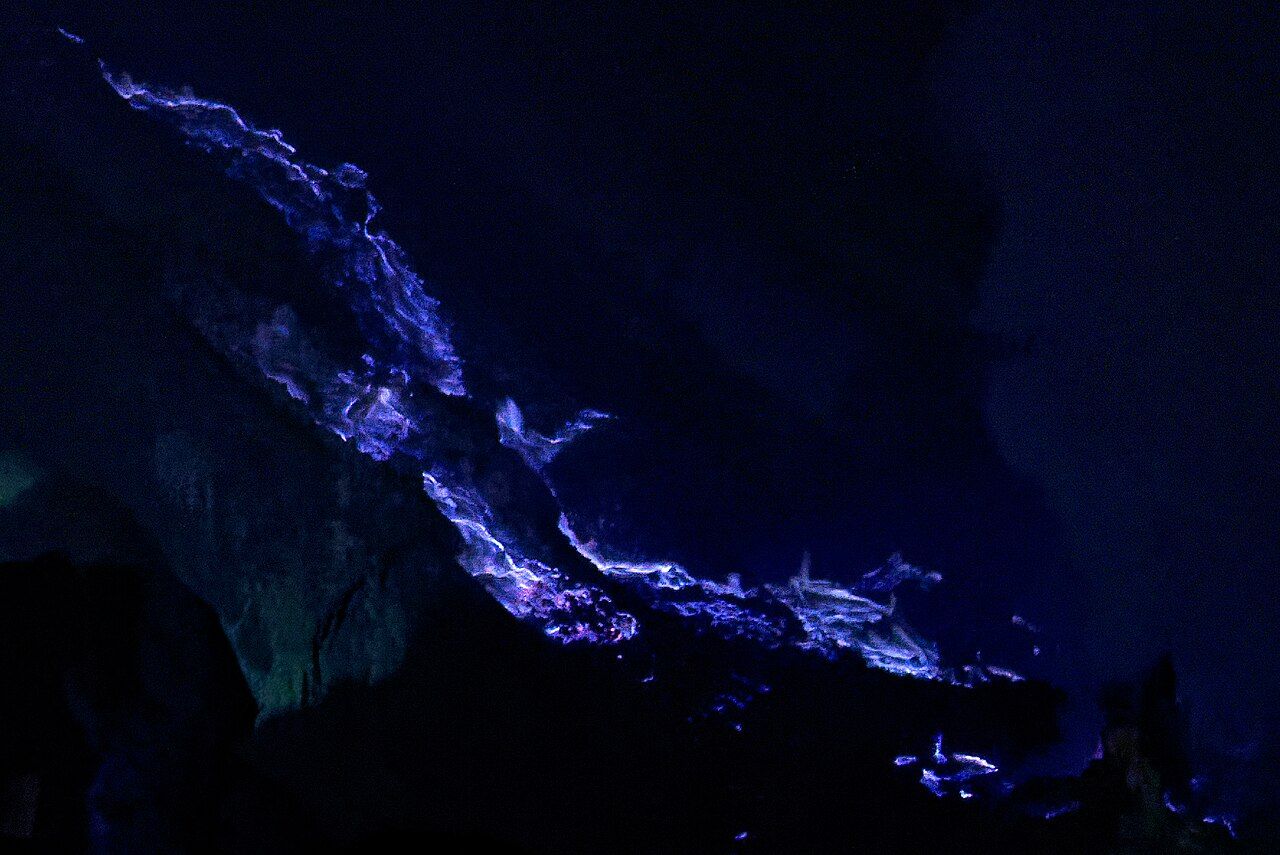
Deep inside Kawah Ijen, close to the shore of the acid lake, the volcano vents gas that is hot enough and rich enough in sulphur to catch fire as it meets the air. The result is a set of flickering blue flames that run along cracks in the rock and sometimes spill downhill like a slow blue stream. By day you would barely notice them. At night they glow against the blackness of the crater, and they have become the main reason many visitors set off for Ijen in the small hours.
What the blue fire is
The flames are not lava. They come from sulphurous gases escaping through vents and fissures at high temperature. When those gases reach the oxygen in the air, they ignite and burn with a pale electric-blue colour that is typical of burning sulphur. Some of the sulphur condenses into liquid, and that liquid can also burn as it trickles over the rocks, which is why the fire sometimes appears to flow.
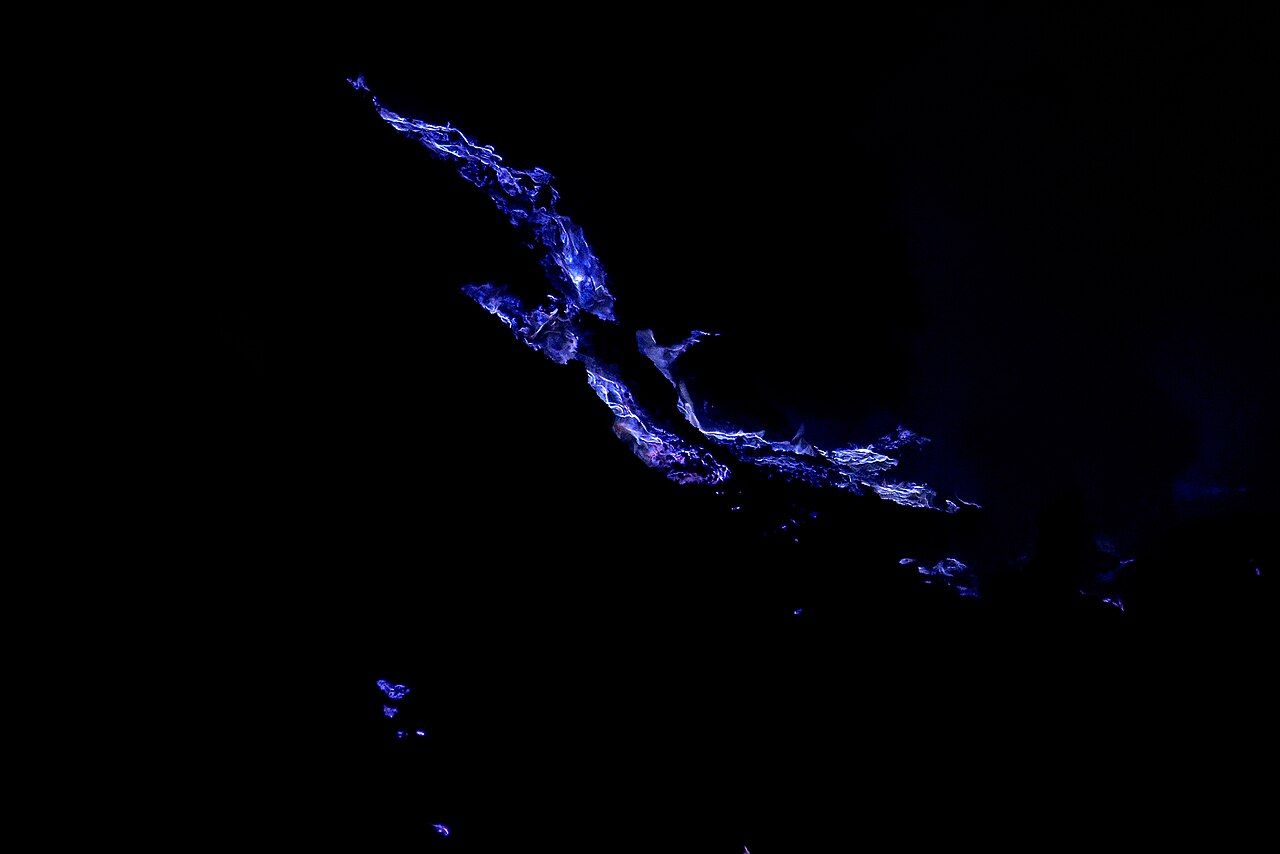
Burning sulphur gives off a blue light at most volcanoes where it happens, but conditions at Ijen make it unusually visible: plenty of sulphur, gas coming out hot, and a crater that is pitch dark before dawn. The flames are part of the same system that feeds the sulphur deposits worked by the miners, whose pipes channel gas from the vents so that it cools into solid yellow rock. You can read more about that in the story on the sulphur carriers.
Why it needs darkness
The blue light is real but faint. Once the sky starts to brighten, it fades into the background and is lost in the smoke and the glare from the rocks. That is why the window for seeing it falls in the darkest hours, roughly from the middle of the night until shortly before dawn. If you arrive at the rim as the sky is turning grey, you may still glimpse it, but the full effect belongs to the deep dark.
This timing shapes the whole trip. You leave for the plateau at night, start walking from the trailhead at Paltuding when the gate opens, and aim to reach the rim with enough darkness left to see the flames. The broader picture of the crater visit, from the start to sunrise on the rim, is in the main guide to Kawah Ijen.
The path into the crater
Seeing the flames close up has traditionally meant going down from the rim into the crater itself, on a steep and rocky path used by the sulphur carriers. It is narrow, uneven and loose in places, with big steps between boulders and long drops beside the track. In the dark, with smoke drifting across it and workers climbing up with heavy loads, it demands real care.
On the same journeyGas, cold and the crater: staying safeAccess to this descent is controlled by the authorities, and the rules have changed several times. At some periods visitors have been allowed down with a guide; at others the descent has been closed entirely, or limited to certain hours or conditions. Some closures follow increases in gas or volcanic activity, while others have been made for safety reasons after accidents. Find out what currently applies before you go, and do not try to slip past a closure or go down without permission. If the descent is closed, the flames may still be visible as a faint glow from the rim, but there is no guarantee.
When the descent is open, it is usual to go with a local guide who knows the path and can read the wind. Let the sulphur carriers pass on narrow sections; they are working, carrying heavy weights on difficult ground, and stepping aside is basic courtesy.
Gas and safety near the flames
The blue fire sits right next to the most active vents in the crater, which is exactly where the gas is thickest. Sulphur dioxide stings your eyes, makes you cough and, in high concentrations, can be dangerous, especially for anyone with asthma or a heart or lung condition. A proper gas mask with working filter cartridges is essential. Do not rely on a scarf or a simple dust mask.
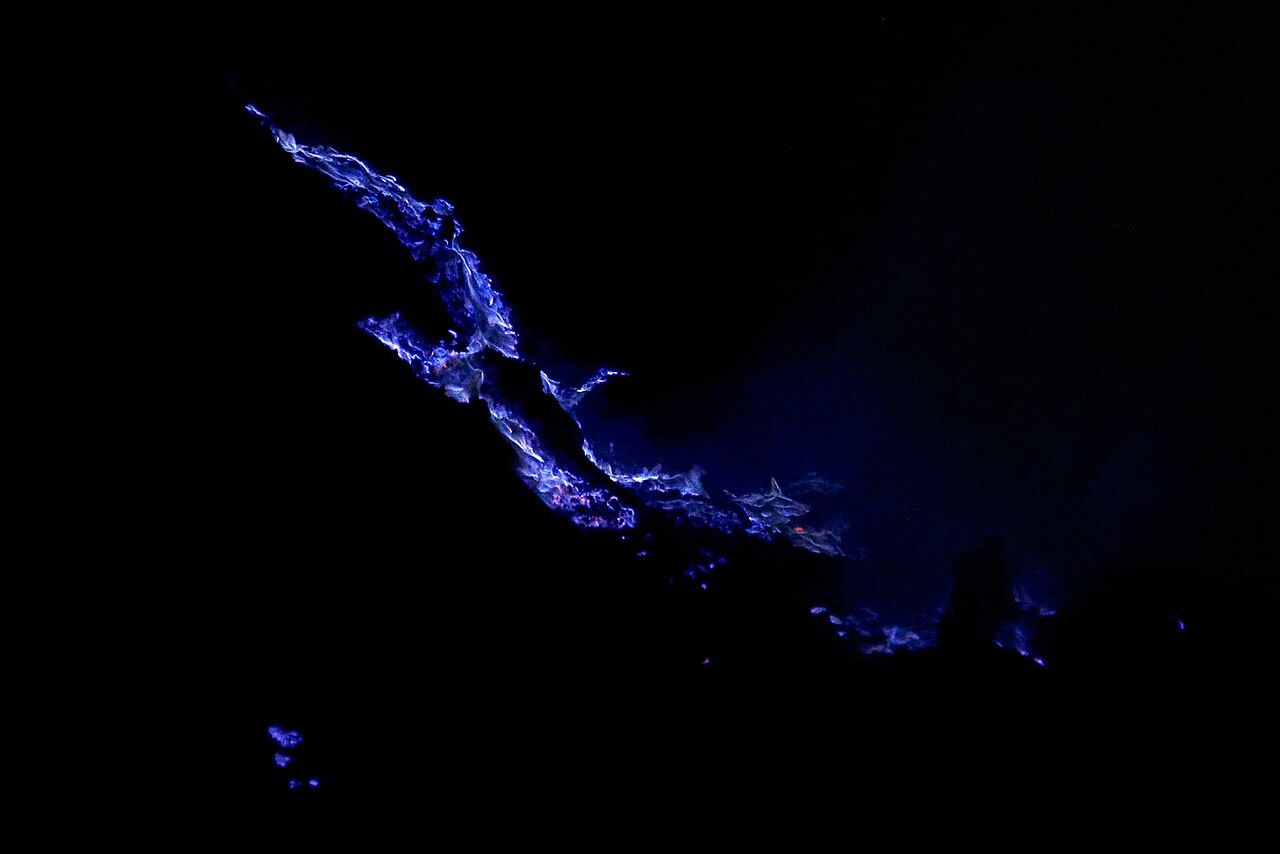
Wind direction controls everything. When the plume blows towards you, visibility can drop to almost nothing and the air becomes painful to breathe. Stay calm, keep the mask on, crouch low if needed and move slowly away from the smoke with your guide. Never step off the path to get closer to the flames: the ground near the vents is hot, unstable and in places covered with molten or freshly cooled sulphur.
- Check the current access rules and alert level before your trip, and again on the day.
- Carry a headlamp with spare batteries and wear shoes with good grip.
- Bring gloves; the rocks are rough and the air near the rim is cold.
- Turn back if you feel dizzy, short of breath or unwell.
- Keep children and anyone with breathing problems away from the crater floor.
Photographing the flames
The blue fire is hard to photograph well. The light is weak, the smoke moves constantly and you are standing on uneven ground in the dark. A camera that can handle long exposures and high sensitivity helps, but tripods are awkward on the crowded, narrow terrain near the flames, and you should never set one up where it blocks the path. Keep your mask on while you shoot, keep your back to the wind where possible, and accept that some of the best moments are better watched than recorded.
Be careful with lights. Bright torches and phone screens pointed at the flames spoil the view for everyone around you and can dazzle people on the path. Point your headlamp at the ground, and switch it off while you watch.
Is it worth it
For many visitors the blue fire is the highlight of a trip to East Java, a sight that does not look quite real even while you are standing near it. But it is also the most hazardous part of a crater visit, and access to it is never certain. Plan the trip so that it is still worthwhile if the descent turns out to be closed: the climb through the forest, the crater at sunrise and the view of the turquoise lake are remarkable on their own. If the flames are on show and the rules allow you to go down, treat the crater floor with respect, follow your guide and leave while you still have the energy for the climb back up.
Photographers on the rim
- Jakub Hałun, CC BY-SA 4.0
- Jakub Hałun, CC BY-SA 4.0
- Jakub Hałun, CC BY-SA 4.0