
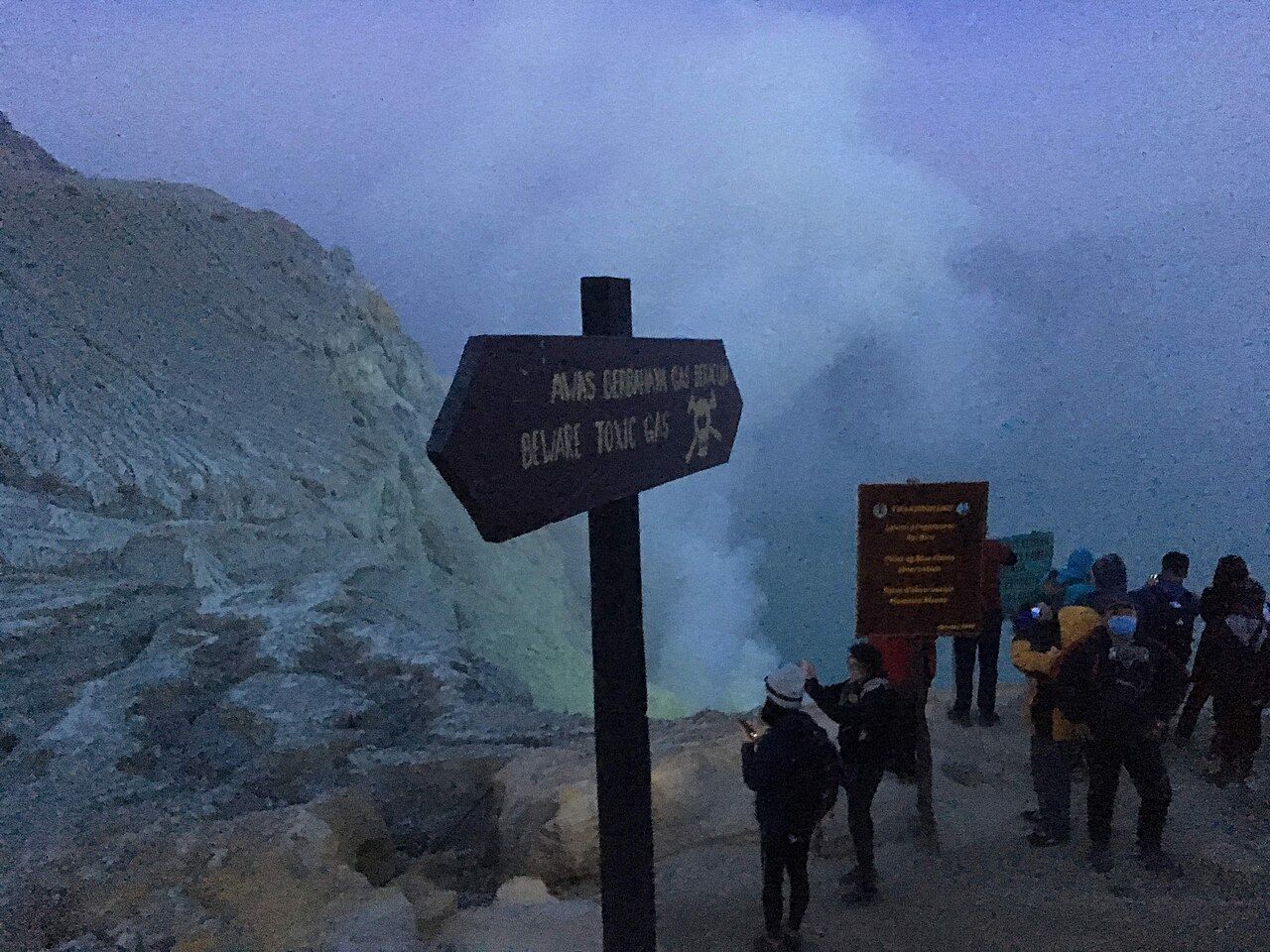
Why Ijen needs respect
Kawah Ijen is an active volcano with an acidic lake in its crater and vents that release sulphur gases continuously. People climb it every night of the open season, most of them without trouble, but the combination of gas, darkness, cold, altitude and steep loose ground means that small mistakes can become serious. A few simple habits take most of the risk out of the night.
Read this alongside our guides to the turquoise crater and the blue fire, which describe the climb itself.
Understanding the gas
The plume rising from the crater's vents is mostly sulphur dioxide and steam, with other sulphur compounds. Sulphur dioxide irritates the eyes, nose, throat and lungs; at higher concentrations it makes breathing painful and can trigger serious attacks in people with asthma. It is heavier than air, so it tends to settle in hollows and on the crater floor when the wind drops.
The plume moves with the wind, and the wind in a crater changes direction often. One minute the air is clear, the next a thick white cloud rolls over the path. When that happens:
- Stop, turn your back to the plume and keep your mask firmly on.
- Do not run on uneven ground; move slowly toward clear air, ideally upwind and uphill.
- Close your eyes briefly if they sting and breathe slowly.
- Wait for the cloud to pass before carrying on, and turn back if it keeps returning.

Masks that actually work
A cloth mask or a surgical mask does very little against sulphur dioxide. What helps is a half-face respirator fitted with cartridges rated for acid gases, sealed properly against the face. Masks of this type are commonly hired out near the trailhead; check that the cartridges are present and not obviously old, that the straps hold and that the seal is tight. A beard reduces the seal.
Wear the mask whenever you are near the crater, not only when the plume is visible, and keep it on during the descent toward the vents if that path is open. Simple swimming goggles help a great deal with stinging eyes.
Who should think twice
The gas is the main hazard for people with asthma or other lung conditions, and the climb itself is a strain for anyone with heart problems. The rim sits well above two thousand metres, the path is steep in places, and the night is cold. If you have a heart or lung condition, are pregnant, or are travelling with young children, speak to a doctor before you go, and be ready to stay at a viewpoint on the trail rather than going to the rim.
Altitude itself rarely causes serious illness at this height, but it does make the climb harder work than the distance suggests. Walk at a pace that lets you talk, rest often, and do not let a group push you faster than you can comfortably breathe through a mask. Anyone who feels dizzy, confused or very short of breath should stop, move into clear air and head back down with a companion.
Carry any inhaler or medication in a pocket, not at the bottom of a bag, and tell your companions where it is.
On the same journeyWhen to go: dry and wet seasonsLight, cold and the trail
Most visitors start from the trailhead at Paltuding in the small hours, so a good headlamp with spare batteries is essential; a phone torch leaves you with one hand and a fading battery. The path is wide but steep in sections and covered in fine, slippery grit on the way down. Shoes with real grip matter more than anything else you wear.
Temperatures near the rim can approach freezing in the dry season, and the wind makes it feel colder. Bring a hat, gloves and a windproof layer, and some water and a snack; dehydration and cold sap judgement.
The path into the crater toward the vents is far more dangerous than the main trail: narrow, rocky and steep, and it runs through the densest gas. Access to it has been restricted at various times, and the miners who work at the bottom use it daily with heavy loads. Where it is open, give the sulphur carriers right of way, and never stand on the outside edge to let anyone pass.
Guides, rules and closures
The rules for visitors at Ijen have changed several times in recent years, including on opening hours, on access to the crater floor and on whether visitors must go with a licensed local guide. Even where it is not required, a local guide adds a great deal in the dark, especially in fog or when the gas is heavy.
The trail may also close on set days for maintenance, during heavy rain, or when gas levels are dangerous. Never pass a closed gate or a barrier marked for workers only. People have been badly hurt and killed here by falls and by gas, sometimes after ignoring warnings.
The volcano alert system
Indonesia rates each active volcano on a four-step scale, from normal at the bottom to the highest level of alert at the top. The levels are set by the national volcanology authorities based on monitoring, and they can change quickly. When Ijen's level rises, an exclusion zone is drawn around the crater and visitors are kept away from it, often for weeks.
Before you travel, check Ijen's current alert level and any exclusion zone, and check again the day before your climb. Nearby Mount Raung has its own level. If the authorities, rangers or your guide tell you to turn back, turn back; the view will be there on another night.
Back to the crater rim for the next walk.
Photographers on the rim
- Christophe95, CC BY-SA 4.0
- CEphoto, Uwe Aranas, CC BY-SA 3.0